


A restaurant group with four sites runs food safety the same way as one with 40. At four sites, a missed check gets picked up by the next shift; scale that to 40, and it can sit unnoticed for months.
Most operations teams could recite HACCP principles and Food Safety Act obligations without much prompting. The real challenge is holding the same standard across sites that each have a different manager, different staff turnover and their own version of “how we’ve always done it”.
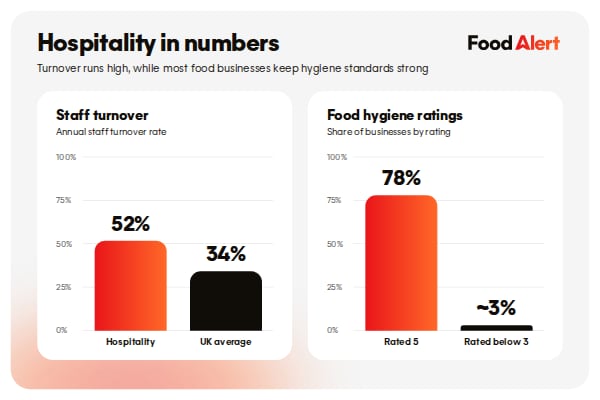
Turnover doesn’t make that easier. The CIPD’s analysis of ONS labour market data puts annual staff turnover in hospitality at around 52% against a UK all-sector average of 34%. A meaningful share of any site’s team is, at any given time, still learning the procedures rather than fully across them.
Where consistency breaks down
Growth changes the shape of the risk. A single-site operator can walk the floor and know, from memory, whether Tuesday’s temperature checks happened; a business with 20 sites has to take that on trust, usually from paper folders, a spreadsheet emailed in on a Friday, or a manager’s word that everything’s fine.
A few patterns show up repeatedly in growing hospitality businesses:
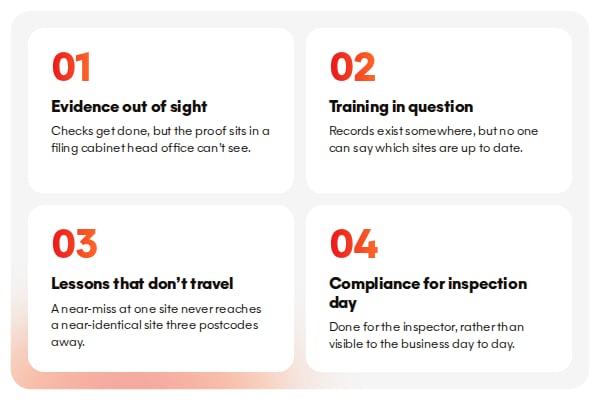
Each of these is manageable alone. Together, across a growing estate, they mean a business can’t easily say whether it’s compliant everywhere, right now.
The cost of finding out too late
The expensive version of this story is well known in the sector. This could be an incident, a Food Hygiene Rating that drops from a five to a two, or coverage that reaches customers before head office has even seen the report. The more common version is quieter. Trust between site teams and head office erodes gradually, because problems only surface once they’re already problems.
Reputational risk in hospitality moves fast, and it doesn’t average out. A badly run site can undo the trust built by 10 well-run ones, especially once review sites and social media get involved. For operators actively expanding, whether through new openings or franchising, that risk grows with every site added unless the standard travels with the growth.
What good oversight looks like
The businesses that manage this well share one habit: nobody is relying on a single person to remember to check. Compliance is built into the daily rhythm of a site rather than treated as a separate task, and someone at head office can see which sites are on track and which need attention this week, not next quarter.
That visibility comes from the paperwork that already exists being in one place, not from adding more of it. A central dashboard that shows completed checklists and overdue risk assessments does more for consistency than another policy document ever will. It lets head office spot a pattern early, a site consistently late finishing checks, a manager who might need support, before it turns into an incident.
Picture a site where checklist completion quietly drifts down over a few weeks. With a live dashboard, someone at head office notices before that site’s next scheduled inspection and follows up early, rather than finding out when a customer or an inspector does. Often the cause is something ordinary, a rota gap or a new manager still learning the system, and on its own it’s not a disaster. Left unnoticed for another month, it easily could have become one.
That kind of early check-in also changes what a compliance conversation feels like for a site manager. Instead of an annual audit that turns up problems after the fact, it becomes a short, regular conversation about what’s working and what needs support, closer to coaching than inspection.
It also changes the relationship between head office and site teams more broadly, as compliance becomes a shared, visible standard rather than something imposed from above and checked afterwards.
Building standards that scale with the business
Most operators who get multi-site compliance right haven’t added admin, they’ve actually removed it. A digital checklist that takes a minute on a phone stands in for a paper log that took five, and a single system holding every site’s risk assessments and training records replaces what used to live only in a folder at head office.
That’s the sort of change Food Alert has spent over three decades helping hospitality businesses make. Its consultants support the development of risk assessments and safety policies that reflect how a kitchen actually runs. Its software, Alert65, gives head office a live view of compliance across every site, without asking managers to work differently to get it.
For operators growing quickly or steadily, the standards that got the business to where it is now don’t usually scale on their own. They need a system behind them and a strategic partner who understands the regulatory detail and the operational reality of running sites that don’t all look the same.
If you’re thinking about how your business keeps standards consistent as it grows, find out more about Food Alert’s consultancy and software.