


The fires at Bodean’s appear to have been lit for the last time. More than two decades after the barbecue brand first brought a taste of the American smokehouse to London, all three of its remaining restaurants have closed, with its future now looking decidedly uncertain.
The closures come despite a major refresh of the business over the past year or so during which Bodean’s installed a new management team and simplified and improved the quality of its menu in an attempt to return the brand to its Kansas City barbecue roots.
Gemma Hampton-Stone was appointed managing director with a brief to revive the business, with meat maestro Richard Turner subsequently brought in as chef director. Sadly, this appears not to have been enough to save Bodean’s bacon.
If this is the end for Bodean’s, it marks more than the demise of one of London’s longest-standing restaurant brands: it also feels like the final chapter in an era when operators and investors believed US barbecue could become a major force in UK casual dining.
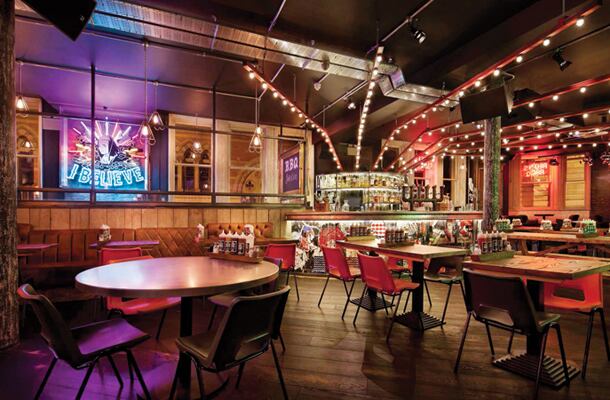
Low-n-slow
French-Canadian restaurateur Andre Blais opened the original Soho restaurant in 2002, when pulled pork and burnt ends were still relatively unfamiliar here. Around a decade later, there was a barbecue gold rush led by Red’s True Barbecue in Leeds and Red Dog Saloon in east London. Both were initially extremely successful and duly unveiled ambitious expansion plans.
Around this time, Big Easy, another barbecue pioneer having launched in Chelsea way back in 1991, also looked to expand, opening an enormous site in Covent Garden and bringing in one of America’s foremost pitmasters to help. Even Jamie Oliver had a go, with the opening of Barbecoa in the city with acclaimed US barbecue chef Adam Perry Lang, but he got his fingers burnt when it closed a few years later.
In the background were a handful of high-quality indies lending the barbecue movement serious foodie credibility, most notably Tom Adams and Jamie Berger’s Pitt Cue, which started life in a trailer on the South Bank and went on to launch a tiny, hopelessly oversubscribed restaurant in Soho in 2012.
Another important name was Joe Walters’ Texas Joe’s, which progressed from pop-ups and an early Farringdon site to open a permanent smokehouse in Bermondsey in 2016. David Carter’s debut restaurant project SMOKESTAK would subsequently become another standard-bearer for top quality London barbecue.
During this period, if you’d asked anyone in the know about the restaurant world – including ourselves – they would have told you barbecue was the next big thing before knocking back a pickleback.
Over the next few years, Red’s True Barbecue and Red Dog Saloon expanded rapidly, but the wheels started to come off a little ahead of the pandemic. Red’s True Barbecue was the major casualty. Having raised serious cash from a credible group of restaurant investors, the business reached eight sites nationally, including a high-profile London restaurant, but went into administration in 2019, never to be seen again in restaurant form (although, curiously, the brand lives on through a range of supermarket barbecue sauces).
Red Dog Saloon fared better and today still has four sites in London and another three dotted around the UK. Yet there wasn’t nearly as much scope for growth as founder Tom Brooke imagined there would be. “There were so many bad barbecue restaurants, people got sick of it,” he told Restaurant in 2019, recounting how Red Dog’s sales had initially gone “through the roof” before the market became saturated.

A difficult model
An oversupply of restaurants was a major driver of the sector’s challenges, but barbecue restaurants also have some financial and operational quirks that make them especially difficult to roll out and run effectively.
First amongst these is food costs. The selling point of the category during the boom was often meaty excess: trays piled with brisket, ribs, pulled pork, sausage and wings. While that was always difficult to offer at a compelling price point in the UK, it has become increasingly more challenging in the wake of rising meat prices and the tightening of customers’ purse strings. Brisket, a mainstay of most proper barbecue restaurant menus, does not come cheap.
On top of this, unlike burgers and steaks, proper barbecue cannot be cooked to order. Brisket, pork shoulder and other large cuts need to go into the smoker many hours before customers arrive, meaning operators must accurately forecast how much they will sell.

Keeping the fires burning
There are still success stories in the Barbecue sector. Big Easy operates four sites in London and a further site just outside the capital in Bluewater and Hickory’s Smokehouse, which was founded in Chester in 2010 now operates more than 40 sites, with more on the way. Now owned by Greene King, it is by some distance the barbecue sector’s biggest success story, but it is not an urban casual dining concept in the mould of Bodean’s or Red Dog Saloon with an estate largely made up of former pubs in suburban, edge-of-town and roadside locations.
But the most exciting developments in the category are on a much smaller scale. Alongside SMOKESTAK and Texas Joe’s a new generation of barbecue-focused restaurants have sprung up, including Acme Fire Cult in Dalston, Black Cactus BBQ in Walthamstow, and From The Ashes BBQ in Hackney, all of which have gained a cult-like status.
Meanwhile, a new generation of chefs are taking the techniques and flavours of US barbecue and combining them with other cuisines. Take Hon’s BBQ in Hackney Wick, which launched earlier this summer with founder Man Hon Luk applying techniques learnt at famed Texan barbecue restaurant InterStellar BBQ to Hong Kong and, more broadly, Chinese flavours (think Sichuan beef short ribs, smoked Taiwanese pork belly and Asian-spiced ox cheek).
West London’s Cue Point is also looking to Texas for inspiration but combining it with co-founder Mursal Saiq’s Afghan heritage (her partner Joshua Moroney was previously head chef at SMOKESTAK). The menu includes oak-smoked brisket with Texas naan, lamb shank with Kabuli pilau and live-fire chicken korma.
Barbecue-focused festival Meatopia also returns next month with a line-up that shows just how creative and vibrant the UK’s independent barbecue scene currently is. In the hands of these generously-tatted new wave pitmasters the artisan barbecue movement is going from strength to strength. So, while the fires may have gone out at Bodean’s, they are burning elsewhere.