


It wasn’t that long ago that Subway was considered the ostensive king of the UK’s QSR market. Throughout the 2010s and even into the early 2020s, the sandwich giant was listed as the country’s largest fast food chain, ahead of other big-name rivals from across the pond like McDonald’s and KFC, as well as homegrown competitors, most notably Greggs.
In recent years, though, the brand’s dominance in the UK has waned. Greggs eventually dethroned it as the largest QSR chain in 2023. Today, according to Meaningful Vision, it is the number three chain in the UK by store count, after Greggs and Costa, and ranks below the likes of McDonald’s, Starbucks and KFC by both footfall and turnover.
Meanwhile, the relatively recent arrival of disrupters Popeyes, Wingstop and Dave’s Hot Chicken has left Subway looking under-invested, lacking direction and off trend. All this is unlikely to have been helped by the absence of a UK management team, as the brand restructured its operating model towards an EMEA hub. With a mega investment deal with Roark Capital sealed in 2024, Subway will no doubt be hoping its recently unveiled new blueprint for growth will help get it back on top.
The strategy itself is split into two components. First is the expansion. Subway says it is aiming to double its footprint across Europe, the Middle East and Africa (EMEA) to 10,000 restaurants within five years. Further UK openings are fundamental to that ambition, with Suzette Burger, VP of strategic execution for Subway EMEA, telling Restaurant’s sister title MCA that hundreds of new sites are planned across the country.
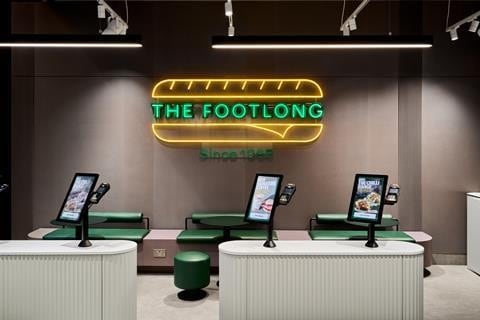
“The UK will play an important role in our growth across EMEA,” she said. Then there’s the blueprint itself. Described as ‘a reimagined Subway experience’, it centres on a new look and brand proposition intended to ‘modernise how guests order and eat’.
For example: the customer journey will be more digitally integrated, with a greater emphasis on self-order kiosks; and guest occasions are being expanded with new offers including an evolved breakfast and coffee menu, new grab and go options, and a ‘Subway After Dark’ dining concept. The latter is currently being piloted in the Netherlands and features warmer lighting, an evening playlist, and a night time menu selection that includes footlong pizzas, loaded waffle fries, and mac ‘n’ cheese.
Introducing a fridge with grab and go sandwich options will allowing Subway to compete more directly with high street rivals like Greggs
According to Burger, After Dark will roll out selectively across the UK based on location and local demand, with early tests showing dinner and late-night daypart growth outpacing current volumes twice over.
Much of this blueprint, of course, is reflective of wider moves seen across the UK’s QSR market in recent years. The new look embraces a cleaner, contemporary energy that swaps the garish fluorescent colour and lighting scheme of the past with a softer, more minimalist palette combining muted tones with directional downlighting and wooden accents.
This extends to the greater emphasis on convenience too. Vertically integrated digital ordering kiosks, which help to boost average order value and reduce labour costs, have become synonymous with the quick-service format in the past decade, as have the designated ‘order’ and ‘collect’ zones to help guide the customer journey.
Introducing a fridge with grab and go sandwich options will further bolster Subway’s credentials in this area, allowing it to compete more directly with high street rivals like Greggs.
Perhaps the brand Subway is most hoping to outshine with its blueprint, though, is one that hasn’t even set foot on UK shores yet. In the US, much has been said and written about the growing dominance of another sandwich slinger: Jersey Mike’s. The fast-growing rival, which was founded in 1954, has seen its market share double in the US double over the last five years, while Subway’s has eroded amid a combination of oversupply, weak average unit volumes, rising costs and marketing and leadership challenges.
In the last decade, Subway has closed more the 7,000 sites across the States, while Jersey Mike’s has added around 2,000 to its estate, becoming the second-largest submarine sandwich chain in the country by sales and store count. Underscoring its momentum, in July Jersey Mike’s filed for a massive $1bn IPO.
Now, Jersey Mike’s has got its eyes on the UK market, with a debut London site in Soho set to launch in the next month and at least three further locations in the capital secured. The group has also signed a five-year deal to be the headline sponsor of the EFL Trophy, which is competed for by League One and League Two clubs; a genius move that will ensure name recognition as the brand expands regionally.
The first tranche of London restaurants will form the launchpad for Jersey Mike’s wider European expansion, with the brand planning to open hundreds more restaurants across the UK and Ireland as it establishes a significant new presence in the market, posing, perhaps for the first time, a significant threat to Subway’s long-term dominance.
As one industry insider put it to me: “Jersey Mike’s is kicking Subway’s ass in the US. Now they’re expanding over here and they’re coming in big, sponsoring the League Cup before they’ve even opened a single restaurant.”
Amid this, the blueprint gives Subway a platform to show it is upping its game, striking out and driving greater relevance. There will be challenges, of course, as it is implemented more widely across the group’s almost entirely franchised estate.
Whether a broader breakfast menu or a dedicated evening offering will give Subway greater traction in those dayparts is hard to determine; the former has ferocious competition from across the quick-service market already, while success in the latter will require Subway to do what no brand has managed to do before and convince UK consumers that a sandwich can be a viable dinner option.
From a brand positioning perspective, critics may question whether the expanded offer is a distraction from what the proposition is famous for and therefore confusing for consumers. Still, the group clearly has confidence in its vision. Announcing the blueprint, Subway noted that in the UK and Ireland, comparable sales have grown by double digits over the past two years, AUV is at a year-to-date record high, digital sales are up double digits, and net restaurant growth remains positive.
To borrow a sports colloquialism: game on!