

Taking to the streets of Paris, if you walk past Notre-Dame and cross the bridge over the Seine towards the Left Bank, the streets begin to tighten and the pavements narrow. The city feels more intimate here - more about corners and cafés than grand monuments.
This is where Paris really shows its culinary identity, with brasseries spilling out onto the pavements, white tablecloths slightly weathered by time, brass fittings catching the light and chalkboards listing the day’s plats du jour.
As you make your way deeper into Saint-Germain-des-Prés, you pass Cour du Commerce, one of those narrow stretches where history and daily life sit almost on top of each other. Here, down this small, cobbled street sits Brasserie des Prés, marked by a red illuminated sign and tables lined along the pavement outside. The design and atmosphere feel rooted in tradition while remaining vibrant, contemporary and sophisticated.
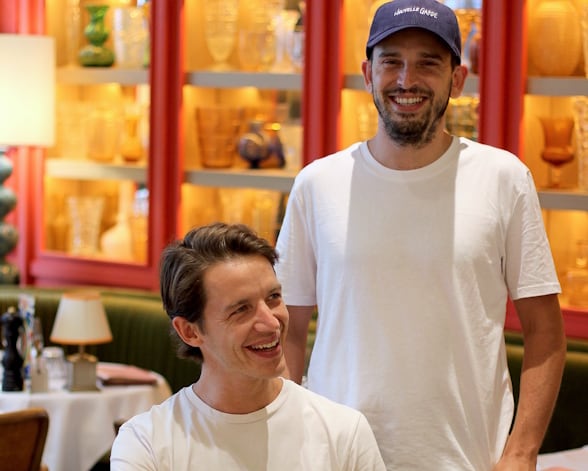
Brasserie des Pres forms part of the French brasserie group La Nouvelle Garde. Founded in 2019 by Charles Perez and Victor Dubillot, the group began with a surprisingly modest ambition. There was no plan to revolutionise French dining or build a nationwide restaurant group. As Perez puts it, the goal was simply to create “one really good restaurant” - a place people would love enough to return to again and again.
And yet, that modest ambition has quietly evolved into something much larger. Today, La Nouvelle Garde operates nine restaurants across France, each offering its own interpretation of the group’s modern brasserie philosophy, and for the first time, the company is looking beyond its home market. With the opening of Brasserie Olivia in Chelsea, La Nouvelle Garde is bringing its distinctly Parisian approach to London, marking the group’s first international expansion and a bold step into a new market.
Brasserie Olivia
Set within the former Côte site on Sloane Square, Brasserie Olivia aims to draw on the traditions of the Parisian brasserie while adapting them for a London audience. In doing so, it raises an intriguing question: can the spirit of a Paris brasserie survive - and thrive - on a London street?
Designed by B3 (responsible for designing all La Nouvelle Garde’s brasseries) the restaurant features an open kitchen, charcoal grill, long dining counter and seafood bar showcasing oysters and langoustines, while a striking lobster tank acts as a focal point for the restaurant. The space seats roughly 160 covers inside, plus 40 to 60 on the outside terrace, with a basement cocktail bar, Venus Bar, designed as a separate nightlife space with its own sound and atmosphere, to open shortly after the restaurant’s official launch.
More than a visual centrepiece, the lobster tank defines the restaurant’s identity from the moment guests walk through the door. “It’s definitely seafood-led,” Perez says. “The seafood counter and the lobster tank really set the tone of the place.”
I’ve been living my whole life in Paris, I wanted to open my mind, meet new people, learn things and discover something new
The message is unmistakable. Before diners even open the menu, the restaurant signals exactly what it wants to be. And if Perez has his way, there will be one dish every guest orders. “If you come to Brasserie Olivia, you really have to try the lobster,” he says.
Despite that emphasis, Olivia is not intended to be a specialist seafood restaurant. Instead, the menu balances shellfish and fish with the classic dishes that have become synonymous with La Nouvelle Garde’s modern interpretation of the French brasserie. Alongside dishes such as the BBQ fresh lobster with garlic and sweet chilli butter sauce, lemon and homemade fries; and fish crudo featuring the catch of the day with citrus fruits and a citrus vinaigrette, the menu also features wood-fired cooking and French brasserie staples, including steak frites with peppercorn or béarnaise sauce and a traditional cassoulet of duck confit, sausage, braised semi-salted shank and Lauragais beans.
Seasonality is be strictly adhered to and produce is sourced from British suppliers wherever possible, while key French ingredients are imported selectively to preserve the authenticity of the cooking. Rather than chasing year-round consistency, menus will evolve with the availability of produce. As the group puts it: ‘We’ll never have tomatoes on our plates in the middle of winter’.


La Nouvelle Garde
La Nouvelle Garde, named in honour of the ‘new guard’ of restaurateurs looking to revive the classic Parisian brasserie, started out as Brasserie Bellanger in Paris’s 10th arrondissement in May 2019. Over the past seven years it has expended steadily into a nine-strong collection of brasseries, each with their own individual personalities, across France, including Paris, Bordeaux, Lille, Marseille, Lyon and Neuilly-sur-Seine.
“The thing with French food is that it’s a very, very large playing field. You can do a lot of different things, and we knew that - and we liked that. We wanted to stay open-minded,” says Perez of La Nouvelle Garde’s balancing act between heritage and reinvention. “We didn’t want to replicate the same thing over again. The idea was always to change, to open different places, and to create something new each time.”
Across its Paris restaurants - including sites such as Brasserie des Prés - that philosophy translates into large, theatrical dining rooms where traditional dishes rub shoulders with modern adjustments in response to changing habits. Roughly 30-40% of each menu remains anchored in French brasserie classics like boeuf bourguignon, egg mayonnaise and steak frites, while with the rest there is more freedom to experiment.
We’re not here just to grow a business or make more money. We’re here because we love what we do
Pricing is deliberately accessible – a feature which was important from the start. “We’ve always wanted a model that would allow us to keep prices affordable, so it could be filled with different kinds of people,” explains Perez. “That’s always been very important to us.”
In Paris, its restaurant spend is typically around £30 for lunch and £60 for dinner, with flexibility for higher spending depending on wine and selection. The aim is not exclusivity, but volume and inclusivity - large rooms that allow a broad mix of customers to eat well at a fair price.
The wine list, meanwhile, is exclusively French and designed to include bottles from almost all of the country’s wine regions. “We are trying to offer a very good sample of all the different types of wine you can find in France,” says Perez.
The overall result is a group that feels consistent in philosophy but not in format. Each restaurant is different by design, shaped by its team and space rather than a fixed template - an approach Perez says is essential to keeping the work creative rather than repetitive.

Choosing London
For a chef who had spent his entire life in Paris, the decision to expand to London was driven by more than ambition. It was about stepping outside a familiar world, embracing a new challenge and testing his restaurant in one of the world’s biggest dining scenes.
“I’ve been living my whole life in Paris,” Perez explains. “I wanted to open my mind, meet new people, learn things and discover something new.”
London’s reputation as a leading global hospitality city made it a natural destination. Its competitive dining scene and consistently high standards offered a clear opportunity to tackle a new and exciting market. “We knew that the London hospitality market is one of the best in the world,” he adds. “The level of the restaurants and the overall hospitality industry to me is very, very impressive.”
Rather than seeing the move as a risk, he views it as an opportunity. The challenge of competing in such a dynamic market was exactly what appealed. “We like the challenge of trying to learn in that market. That was the main reason we decided on London.”
The team also believes there is room in London for its style of cooking and hospitality. “We considered there was a place for the type of food we do, the type of restaurant we run and the work we do,” says Perez. “We’re really proud to have the opportunity to show this to a UK audience, and we will do so with a lot of humility.”

The challenges of London
Yet the move across the Channel has not been without its obstacles. The creation of Brasserie Olivia and a shift in territory represents both an expansion and a disruption of the group’s model.
While the restaurant will occupy a highly-prized site on Sloane Square, the posh London location was not its first choice. The group had initially planned to open in Shoreditch, where it had secured a strong site, but the deal ultimately fell through. Instead, a new space in Chelsea emerged, and once they saw its potential, the direction changed.
“We were supposed to be in Shoreditch… but we lost it,” says Perez. “We found this amazing site, saw what potential it had, and decided to go to Chelsea because of the site. “It’s always a matter of opportunity, finding the right place and imagining what you can do with it.”
Perez is also clear about the wider economic pressures shaping the London restaurant market. “When you look at all the costs you have when launching restaurants in London - it’s crazy,” he says, pointing to rent, VAT, business rates and supplier costs that, he argues, ultimately mean “the customer ends up paying for” them.
The thing with French food is that it’s a very, very large playing field. You can do a lot of different things, and we knew that - and we liked that. We wanted to stay open-minded
He highlights rent in particular, noting that it can be “three times higher than in Paris,” underscoring a key challenge of operating in London.
Brexit hasn’t helped either, particularly when it comes to bringing in staff from France. The original idea was to create a fluid exchange between teams, bringing French staff to London and allowing international collaboration across the group, but Perez says it has now become far more difficult - and in some cases no longer possible - to bring chefs and staff from France. “We wanted to bring people from France within the company, so they could get to know the London site, and also for people here to meet them - to have that exchange, to meet the French team on the other side.” However, that vision has largely been blocked by post-Brexit restrictions, which require non-UK residents to meet specific requirements in order to work in the UK.
Against that backdrop also sits a more personal detail: the restaurant’s name. Perez describes the personal complications that came with launching the London project in a post-Brexit context, saying it was “very hard even as the founder to be allowed to be here”. Ultimately, the project became possible through his wife Olivia, who has a British passport. “Using her name felt like the right way to acknowledge her role in everything,” says Perez.

Protecting Identity While Expanding
As La Nouvelle Garde moves beyond France, the central question becomes how to preserve its Parisian culture. For Perez, the answer is not structural but human. “It comes down to purpose and people,” he says. If the right teams share the same values around food and hospitality, the culture can survive expansion.
“As founders and co-founders, we do things with passion, and people in the team share that. When you’re surrounded by people who genuinely share a passion - for food, for customers, for creating good projects and being kind to others - it becomes much easier to maintain that culture.”
We didn’t want to replicate the same thing over again. The idea was always to change, to open different places, and to create something new each time
He is also careful to emphasise that growth is not the group’s primary objective. “We’re not here just to grow a business or make more money. We’re here because we love what we do.”
With that said, Perez hints that the current economics of operating restaurants over here means that more could follow. “Only one site is not profitable, because the rents are so crazy, so you need more projects to create a healthy company.” Rising costs, he adds, make it increasingly difficult to operate sustainably, shaping expansion as a necessity rather than a choice. “UK expansion will happen step by step.” For now, however, attention remains firmly fixed on making the first opening work. “We are focusing on this one,” Perez says, pointing to the group’s guiding principle of quality over quantity. With Brasserie Olivia the goal is simple: to ensure that what began as a single Paris restaurant can still feel like itself, even when transplanted into a very different city.